
The Coolest Facilities
With state-of-the-art teaching and research facilities on Centennial Campus, ECE promotes ongoing research and collaboration between industry located on campus and other departments.
ECE’s administration and main teaching labs are located in Engineering Building II, with additional research labs spanning the Monteith Research Center and Keystone Science Center.
MakerSpaces
In late 2016, the Department of Electrical and Computer Engineering opened the ECE MakerSpace in Engineering Building II, consisting of two facilities – the Robert M. Kolbas MakerSpace, and the William F. Troxler MakerSpace. The two spaces serve to provide all of the resources students need to realize electronics and fabrication projects, both for Senior Design and other coursework as well as extracurricular and personal experimentation and creation.
The Kolbas MakerSpace provides all the tools required for students to work on electrical projects with state-of-the-art testing and soldering stations, Pick-and-Place component placement machine, in addition to a dozen 3-D printers to aid in prototyping.
The Troxler MakerSpace allows for fully-fledged fabrication with a complete wood and metal workshop, including a ShopBot CNC router and a WAZER waterjet cutter.
The MakerSpace enables and encourages students to be involved in hands-on engineering projects in their coursework and of personal interest.
Teaching Labs
The Electrical and Computer Engineering curriculum is designed to allow each student the opportunity to gain knowledge and complete comprehension of all concepts in this field. The department is able to see that these demands are met by maintaining teaching labs, technical support staff, modern computing equipment, and industry standard software.
The labs include spaces devoted to embedded systems, integrated circuit design, microelectronics, power electronics, wireless networking, and mechanics.
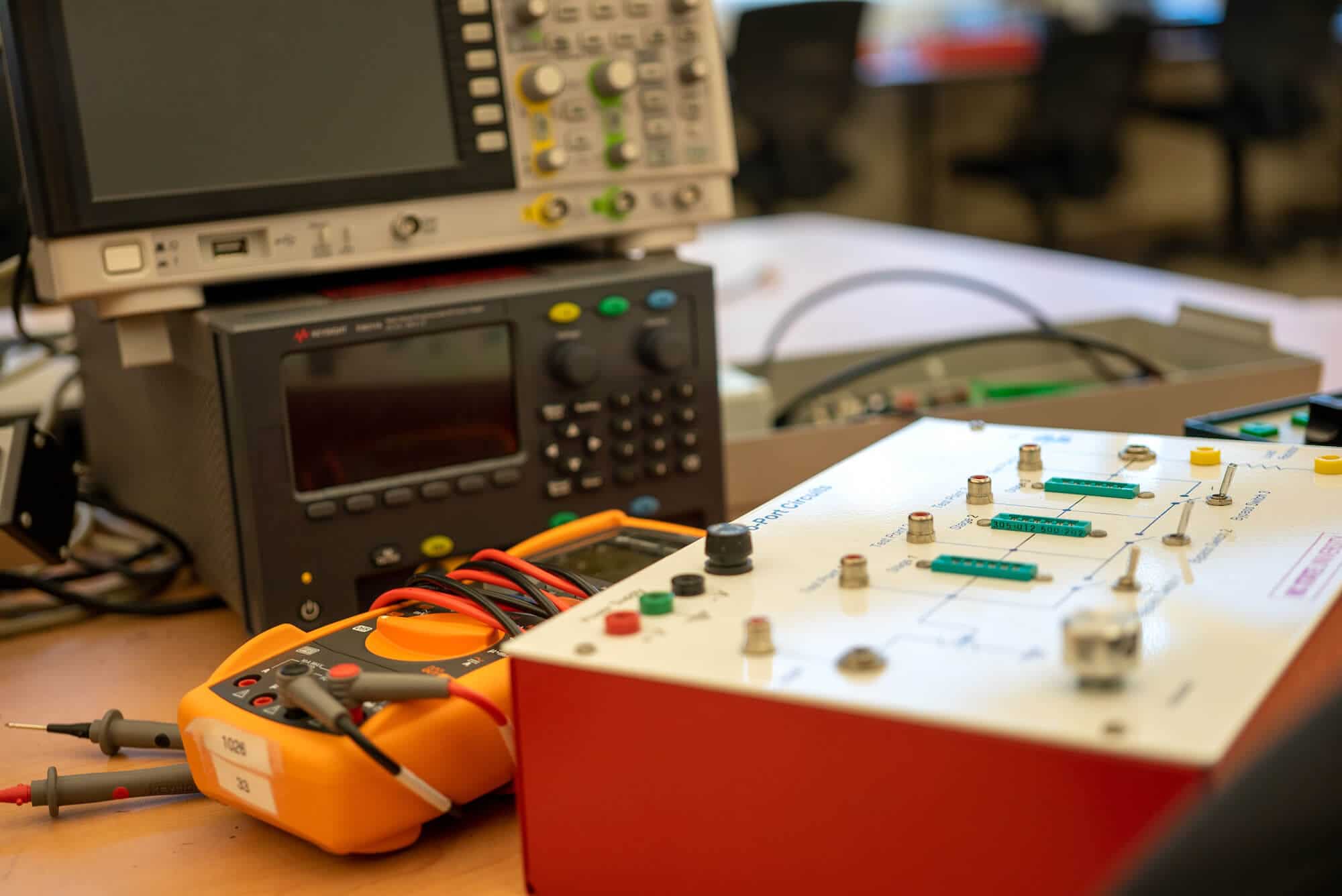
Troxler Design Center
The Troxler Design Center is named in recognition of William F. Troxler, and is dedicated to the Department’s Senior Design courses. Originally located in Daniels Hall, the center moved in the Fall of 2005 to a larger facility in Engineering Building II.
At ~2,000 sq. ft., the Troxler Design Center is the ECE Department’s largest lab, and contains workspace and storage space as well as multiple meeting areas for group meetings or presentations. Large, high-quality workbenches make up the 20 stations for project teams, which also include a dedicated computer for each team. Cutting-edge test equipment and instruments are provided throughout the lab, thanks in large part to the generous donations of William F. Troxler and the Troxler family.
PREES Lab
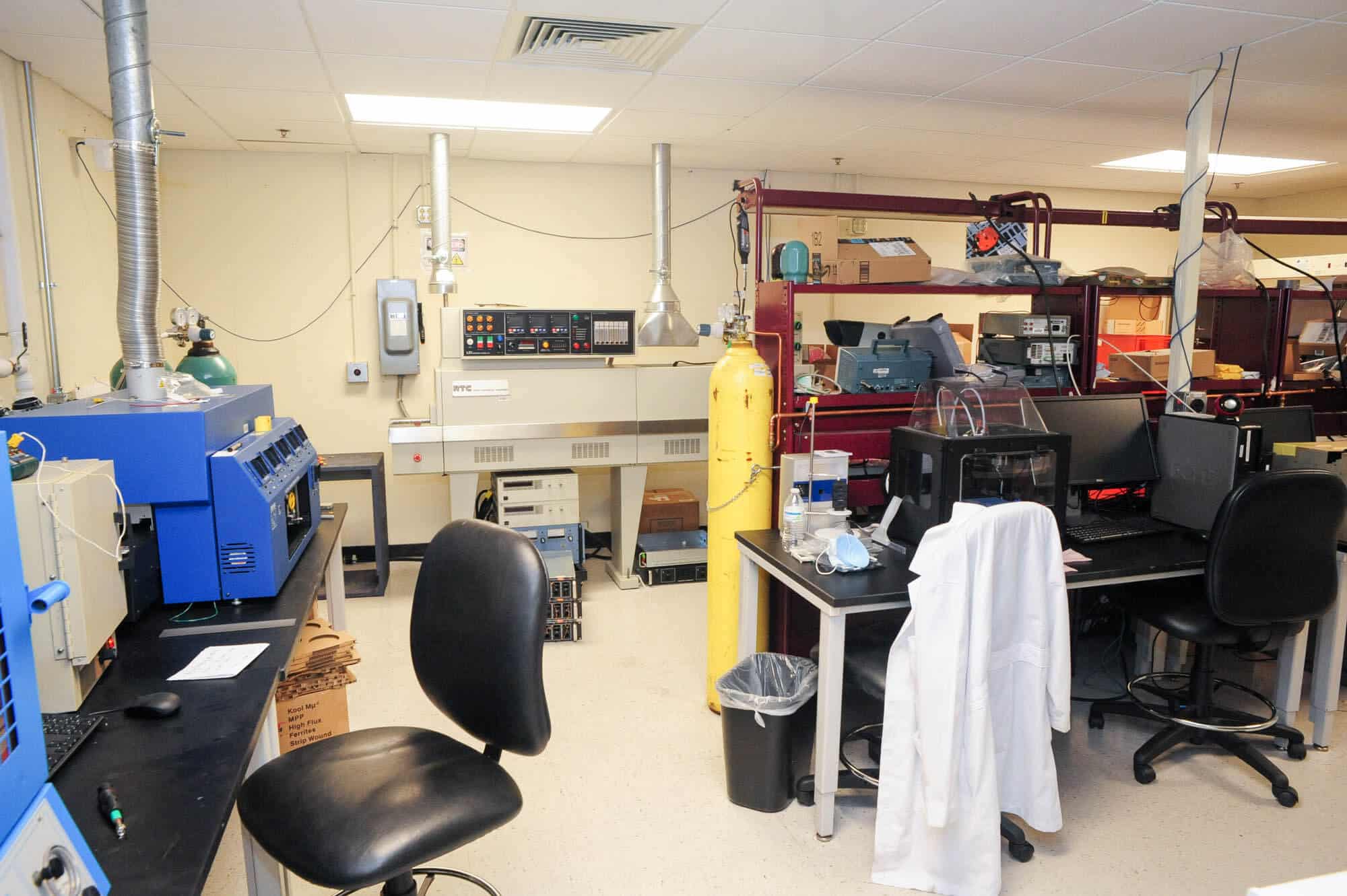
The Packaging Research in Electronic Energy Systems Research Lab is a one of a kind power electronics packaging and design lab.
The Laboratory for Packaging Research in Electronic Energy Systems is developing a new packaging discipline – “Printable Power Electronics,” which focuses on evolving 3D printing technologies of ceramics, metals, and polymers to provide rapid, flexible methods for physically creating unique 3-D electro-physical power circuits.
Users begin with high-level multi-physics simulations to allow early device characterization. Conventional methods of manufacturing are combined with new 3D printing methods including additive manufacturing. The Lab has processes to etch DBC, 3D print conductive interconnects and package encasements, embed thermal cooling, mount power, and signal devices, use ribbon and wire bonding, and apply encapsulate. Designs undergo complete electrical testing with advanced instrumentation. All procedures are being developed in order to accommodate copper processes within the lab.
Nanofabrication Facility
The Nanofabrication facility is located in the Larry K. Monteith Engineering Research Center and occupies a 7400 sq. ft. cleanroom. The facility has a full range of micro and nano-fabrication capabilities including: photolithography, reactive ion etching (RIE), deep RIE, low pressure chemical vapour deposition (LPCVD), plasma enhanced CVD, rapid thermal anneal, thermal oxidation, solid source diffusion, thermal and e-beam evaporation, sputtering, chemical mechanical polishing, various wet etching and cleaning processes, along with various characterization tools.
Many of the tools are capable of processing on a broad range of substrates such as semiconductor glass, ceramics, and plastics with sizes from small pieces to 6″ wafers.
Liquid Order
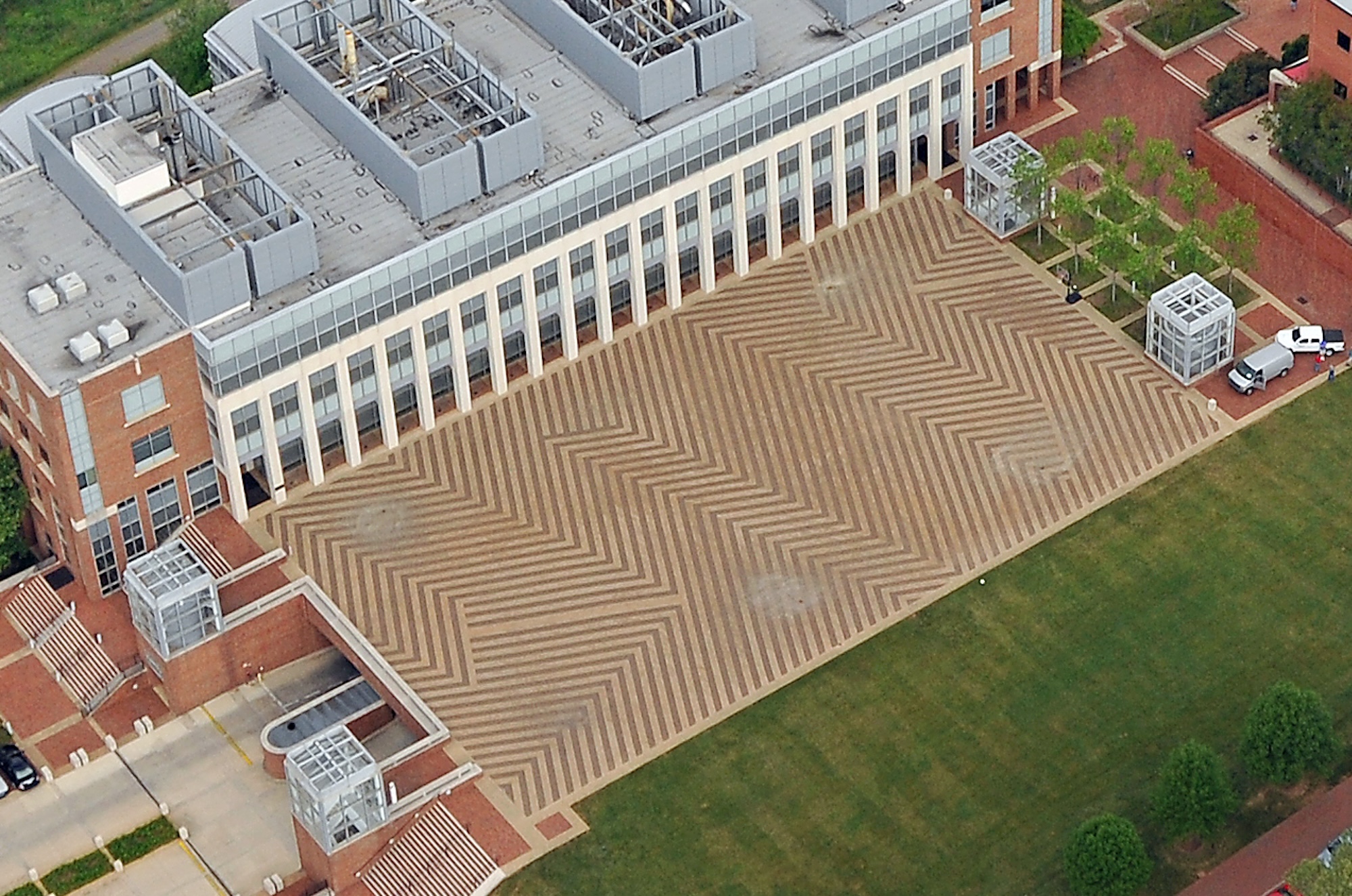
Located in the southern section of Centennial Campus resides a curious art installation. Liquid Order, the title of the plaza adjacent to the MRC (Monteith Research Center) is the creation of Jun Kaneo. Internationally renowned for his sculpture and artistry, Kaneko was commissioned by North Carolina State University to develop a piece of architectural art where art meets science. The plaza pattern speaks to the power of investigation and research, change and growth, and the complexity found in simple things.
The design produced here is a complex set of parallel lines that shift at unexpected intervals. As a result, this piece simultaneously reflects the occurrence of order and unpredictability found in nature. It also represents the adaptation and innovation which is crucial to the research field.
Liquid Order is a 120 by 200-foot plaza unveiled in March 1997 that provides common space for the MRC “academic neighborhood.” This space is designed to be a meeting area that can also serve as an event or ceremony location.
Centennial Campus
The Raleigh-Durham area is consistently listed as one of the best places to live in the country. Located just a few miles from the “epicenter of innovation”—Research Triangle Park—our students and graduates have abundant opportunities for internships, co-ops, and employment with leading technology companies. When it’s time to relax and take a break, the beaches and mountains of North Carolina are an easy drive from Raleigh.
Long known as a national hub for research, innovation and public-private partnership, Centennial Campus is home to the College of Engineering and a number of research centers, institutes, and laboratories. Not to mention 76 industry, government and nonprofit partners.
But it’s more than a research park.
Centennial Campus is a bustling—and growing —community. A sprawling landscape with walking trails, a championship golf course, restaurants, condos and a hotel. A mini-city nestled around Lake Raleigh. And, just as important, a destination for fun.
You can catch a movie on the vast Oval Lawn, chow down at a food truck rodeo, enjoy a live concert on the shore, and kayak by moonlight on the lake (not all at once, of course).
The state-of-the-art campus is a collision of learning, research, and innovation—leading to game-changing advancements and technologies that shape the world.
An entrepreneurial campus
135+
Startups Launched
1,010+
U.S. Patents issued
595+
Products to Market
Visit ECE
Don’t just look at the pictures, please come visit our ECE facilities on Centennial Campus and see all that we have to offer.